Metabolic Energy Pathways
Energy, recovery and performance in bodybuilding

MOTS-C, SS-31 and NAD+
Energy, recovery and performance in bodybuilding.
In bodybuilding and intense training, cellular energy production and muscle recovery are fundamental. Mitochondria, known as the “power plants” of the cells, play a central role in this. Three compounds have captured theoretical attention for their potential to optimize mitochondrial function: MOTS-C, SS-31 and NAD+.
SS-31
Protects mitochondria during energy production, keeping them stable and efficient even under intense stress, which could favor strength, endurance and recovery.

MOTS-C
It is a mitochondrial peptide that helps cells better use sugar and fat as fuel, in addition to improving communication between mitochondria and the cell nucleus to adjust genetic activity according to energy needs.

NAD+
It is the molecule that transports energy within the cell and activates proteins that repair and maintain cellular function, ensuring that the energy produced is used efficiently.

The combined use of these three compounds could offer benefits in various scenarios within bodybuilding, optimizing energy, recovery and cellular resistance. Below are five conceptual scenarios:
| Theoretical scenario | Training phase / situation | Expected effect of the combo / theoretical notes |
|---|---|---|
| Caloric deficit / extreme definition | Reducing body fat while maintaining muscle mass | Improves efficiency in nutrient use, protects mitochondria, favors recovery and allows maintaining training intensity. |
| Periodization peak / maximum performance | Reaching maximum strength or volume in the most intense phase | Optimizes energy production, reduces cellular stress and allows intense training with better recovery between sessions. |
| Chronic fatigue / low energy without apparent cause | Person who trains and eats correctly, but feels tired, has trouble sleeping or feels exhausted | Possible benefit: improves energy efficiency of cells, protects mitochondria and can increase vitality. Caution: First identify the cause. |
| Recovery after muscle injury | After rest or load reduction due to injury | Favors cellular and mitochondrial repair, improves energy efficiency and helps recover strength and energy to restart training. |
| Recovery after theoretical overtraining | After cycles of extremely intense training | Accelerates cellular recovery, restores mitochondrial function and available energy for the next training phase. |
In all these scenarios, the objective of the MOTS-C + SS-31 + NAD+ combo is to maximize cellular energy, protect mitochondria and favor recovery, whether in phases of caloric deficit, maximum performance, chronic fatigue, injury or overtraining. However, in cases where fatigue does not have a mitochondrial origin, the cause should first be identified before considering any intervention.
Programming/Cycle
PHASE 1
Planning starting with SS-31
SS-31 is considered the “preparer” of the cell and the mitochondria. The theoretical idea is that it protects and stabilizes mitochondria, optimizing the structure and efficiency of the mitochondrial membrane before MOTS-C and NAD+ act to increase energy and metabolic signaling. In other words: SS-31 creates the proper ground so that the other compounds can function more effectively.
Theoretical interval and dosage of SS-31:
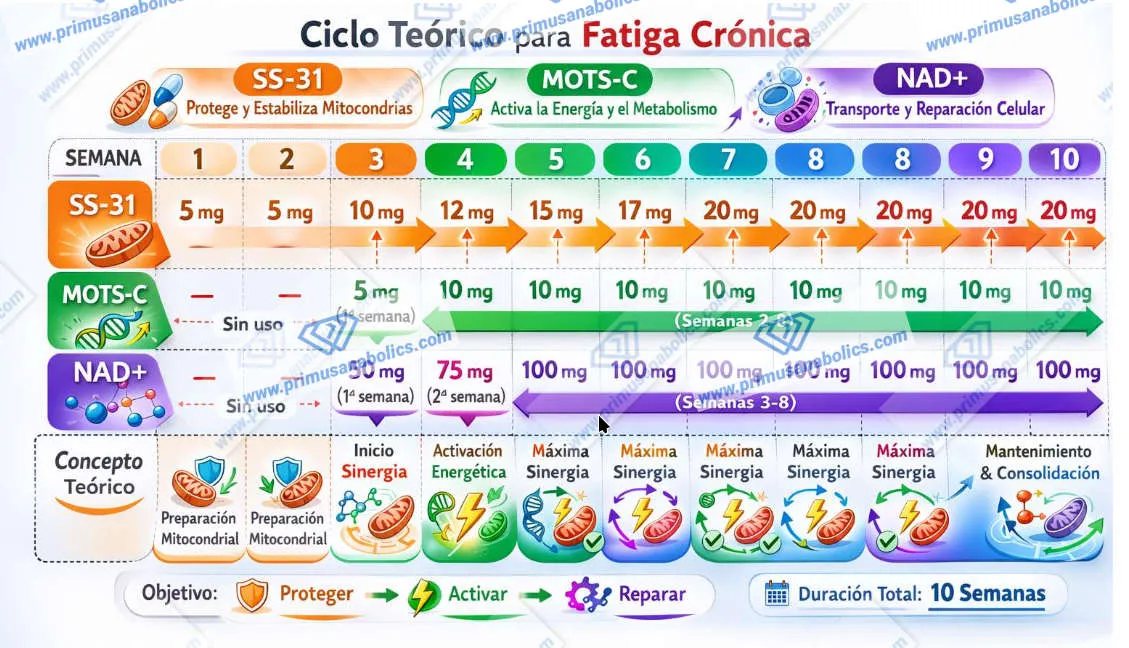
- Duration: 10 weeks
- Start: 5 mg/day for the first two weeks
- Progression: increase to 10 mg/day for the last eight weeks
Starting with the minimum dose allows mitochondria to adapt and avoids metabolic overload; gradual progression ensures that cells are optimized for the next step.
PHASE 2
MOTS-C phase planning
After preparing the mitochondria with SS-31, the next theoretical step is MOTS-C, which activates the cell’s ability to produce and use energy, optimizing mitochondrial-nuclear communication. The advantage of introducing it in week 3 of SS-31 is that the mitochondria are already protected and ready to handle an increase in metabolic activity.
Theoretical interval and dosage of MOTS-C:
- Duration: 8 weeks (starting week 3 of SS-31)
- First week: 5 mg/day
- Following weeks: 10 mg/day
The first week allows cells to adapt to metabolic activation; the following weeks with 10 mg maximize the energetic effect without overloading the cell.
Phase 3: NAD+ – Energy transport and repair
Ensures that the generated energy is correctly transported, activates sirtuins for cellular repair, maintains mitochondrial health and improves general resistance.
- Duration: 8 weeks (starting week 3 of SS-31)
- Start: along with Mots-C
- First week: 50 mg/day
- Second week: 75 mg/day
- Following weeks: 10 mg/day
It is introduced at week 3 to take advantage of the fact that the cell is already protected and metabolically activated, maximizing efficiency and recovery.
Week-by-week cycle summary, daily doses.